
Planning an international relocation is an exciting milestone, whether it’s driven by a career move, a lifestyle change, or a strategic cross-border business expansion.
However, one of the most persistent and costly misconceptions we see when advising private clients is the belief that packing a suitcase and handing back the keys to a UK house automatically cuts your ties with HM Revenue & Customs.
In reality, the UK operates a rigid, rules-based framework known as the Statutory Residence Test (SRT). Introduced in Schedule 45 of the Finance Act 2013, the SRT strictly governs whether an individual is treated as UK tax resident in any given tax year (6 April to 5 April).
Get the sequencing wrong and you risk remaining trapped in the UK tax net – with your worldwide income, gains, and even your estate exposed to UK tax – long after you’ve left these blustery shores. Below, we set out how the SRT operates, how your choice of destination changes the practical risk, and some of the wider traps that catch business owners and company directors in particular.
The three-step architecture of the Statutory Residence Test
The SRT is applied in a strict order of priority. You work through the rules in sequence: if an Automatic Test at Step 1 or Step 2 is met, the analysis ends there. Only if both prove inconclusive do you move to the more nuanced Sufficient Ties Test at Step 3.
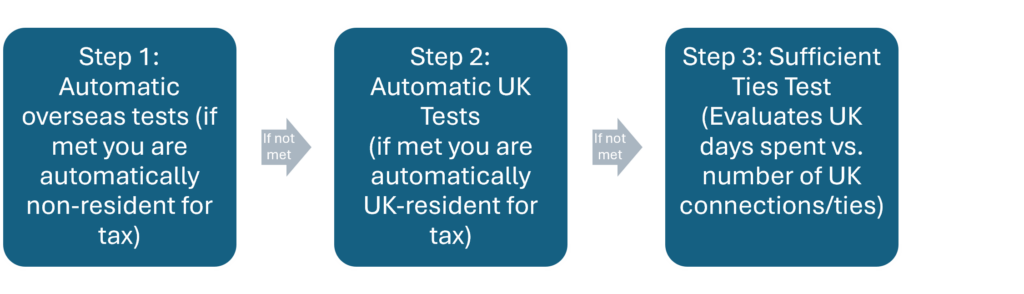
Step 1: the automatic overseas tests (securing non-residence)
Meet any one of the following and you’re conclusively non-UK resident for the tax year, with no need to consider your ties at all:
- Under 16 days in the UK – you were resident in the UK in one or more of the previous three tax years, but spend fewer than 16 days in the UK in the current year.
- Under 46 days in the UK (arrivers) – you were non-resident in all of the previous three tax years and spend fewer than 46 days in the UK.
- Full-time work overseas – broadly, you work sufficient hours abroad (averaging around 35 hours a week, calculated over a defined reference period), take no significant break from that overseas work, spend fewer than 91 days in the UK, and work more than three hours a day in the UK on fewer than 31 days.
That third element of step 1 is usually the one that matters most for employed and self-employed leavers, but it’s also the one that carries the most risk of slipping – a single 31-day gap without an overseas workday (an unplanned career break, a long summer holiday, an extended illness) can cause the whole test to fail for the entire tax year, throwing you back onto the ties test with a materially lower day allowance.
Step 2: the automatic UK tests (conclusive UK residence)
If Step 1 isn’t met, the question becomes whether you’re automatically caught as UK resident:
- The 183-day rule – you spend 183 days or more in the UK in the tax year.
- The “only home” test – you have a UK home available for at least 91 consecutive days (used for at least 30 days in the year), while having no overseas home, or an overseas home you’re present in on fewer than 30 days across the whole year.
- Full-time UK work – you work full-time in the UK, assessed over a 365-day period that at least partly falls in the tax year.
A point that trips people up here: a property only becomes your “home” for these purposes once you actually start using it as one – not from the date a lease begins or a purchase completes. Timing matters, particularly where one spouse relocates ahead of the rest of the family.
Step 3: the sufficient ties test (the grey area)
If neither Step 1 nor Step 2 resolves the position, residence turns on a combination of UK days and the number of “ties” you retain to the UK. For leavers (UK resident in one or more of the prior three tax years), HMRC looks at five specific ties:
- Family tie – a spouse, civil partner, or minor child remains UK resident. There’s a limited relaxation where a parent spends fewer than 61 days in the UK in person with a resident child, but no equivalent relaxation exists for a spouse.
- Accommodation tie – UK accommodation available to you for a continuous period of 91 days or more, used for at least one night.
- Work tie – working in the UK for more than three hours a day on 40 or more days in the tax year. Directors’ duties count here, so board meetings attended in the UK are relevant.
- 90-day tie – spending more than 90 days in the UK in either of the previous two tax years.
- Country tie – the UK is the country in which you were present at midnight on more days than any other single country, in the tax year.
Day count thresholds for UK leavers:
| UK days spent in tax year | 1 tie | 2 ties | 3 ties | 4+ ties |
| 16 – 45 days | Non-resident | Non-resident | Non-resident | UK resident |
| 46 – 90 days | Non-resident | Non-resident | UK resident | UK resident |
| 91 – 120 days | Non-resident | UK resident | UK resident | UK resident |
| 121 – 182 days | UK resident | UK resident | UK resident | UK resident |
Low-tax and high-mobility destinations, and the country tie.
If you relocate somewhere like Monaco but continue splitting your time across several jurisdictions rather than settling in one place, the country tie can still catch you out – if the UK remains the single country where you spend the most midnight-days in the tax year, that tie applies even if you spend the majority of the year outside the UK overall. This is a common blind spot for clients whose move isn’t a single clean relocation but a more fluid pattern of time split across two or three bases; it’s easy to feel confident you’ve “left” the UK while inadvertently remaining its most-visited country on the calendar.
Treaty protection versus non-treaty countries.
Relocating to a country with a Double Taxation Agreement with the UK – Spain, Australia, Germany, and the US among them – means that if you’re found resident in both states, the treaty’s Article 4 “tie-breaker” (permanent home, then centre of vital interests, then habitual abode, then nationality) can assign sole residence to one jurisdiction for treaty purposes. Monaco illustrates the opposite scenario: it has no comprehensive double taxation agreement with the UK, so there’s no treaty mechanism to fall back on if the SRT analysis doesn’t go your way. In a non-treaty destination, the domestic UK rules carry the full weight of the analysis on their own, and getting them wrong leaves you fully exposed to UK tax on top of whatever applies locally.
Tax year realignment.
The UK’s 6 April to 5 April tax year sits awkwardly against the calendar-year basis used across most of Europe and beyond, Monaco included. Reconciling reporting across overlapping years – particularly around a mid-year move – needs careful planning to avoid income or gains falling into charge twice.
Crucial pitfalls for departing expats
Split year treatment
You’re technically either resident or non-resident for an entire tax year – there’s no such thing as being “half resident” in law. Split year treatment is a set of statutory cases that, where met, divide the tax year into a UK part and an overseas part for the purposes of certain income and gains. The most relevant cases for someone leaving the UK are: starting full-time work overseas, being the partner of someone who qualifies on that basis, and ceasing to have any home in the UK at all.
None of these are automatic, and the third is unavailable to anyone retaining a UK property. Where a family relocates in stages – one spouse first, the rest following months later – each individual’s split year position needs testing separately, and a case being available to one spouse doesn’t necessarily extend it to the other on the same terms.
The split-year dividend trap for company owners
This is one we see catch out director-shareholders more than almost anything else. Split year treatment relieves *foreign* income arising in the overseas part of the year – it does nothing for UK-source income. Dividends from UK-resident companies remain within the UK income tax charge regardless of split year treatment.
The relief that normally makes UK dividends tax-free for a non-resident is a limit on liability under [section 811 of the Income Tax Act 2007] (https://www.legislation.gov.uk/ukpga/2007/3/section/811) – but that relief only applies to someone who is non-UK resident for the *whole* tax year. In a split year, you remain UK resident for the year as a whole, so the relief simply doesn’t apply, and a dividend paid in the overseas part of a split year is taxed in full at standard UK dividend rates. For anyone planning to extract retained profits or clear a director’s loan account tax-efficiently on relocation, the timing of departure relative to the tax year – not just relative to the calendar – is often the single biggest lever available.
Company residence risk for director-shareholders
If you’re a director as well as a shareholder, your own move can put your company’s tax residence at risk, not just your own. UK-incorporated companies remain UK resident regardless of where they’re managed – but under UK law, a company is *also* treated as resident wherever its central management and control actually sits, which is a question of fact rather than of paperwork. Where a sole director relocates and continues running the business personally from abroad, HMRC’s starting assumption is that control has moved with them, which can create unwelcome dual residence in the destination country as well. Broadening the board with a genuinely empowered UK-resident director, before departure, is typically the central mitigation – but it needs to be real delegation, evidenced in how board meetings are run, not just a name added to the register.
The midnight rule and the deeming rule
A “day spent in the UK” is formally a day on which you’re present in the UK at midnight. Frequent travellers who pass through the UK without staying overnight should be aware of the deeming rule, which can count daytime-only visits as UK days once you hold three or more UK ties, were UK resident in a recent prior year, and exceed 30 such days in the year – after which every further qualifying day counts.
Temporary non-residence: it’s not just about capital gains
The temporary non-residence rules are well known for taxing capital gains realised shortly after departure if you return too soon. What’s less widely appreciated is that the same principle now extends further: recent legislative changes have tightened the rules around distributions from close companies received while temporarily non-resident, removing an exclusion that previously protected profits arising after departure. If you were UK resident in four or more of the seven tax years before you left, and you return within five complete tax years, income that looked tax-free at the time it was received can be pulled back into charge in the year you return – with no double tax relief available if your destination doesn’t tax dividend income domestically. Five years and a day is the statutory minimum; in practice, a margin beyond that is usually the safer target.
Inheritance tax hasn’t gone away
Since 6 April 2025, exposure to UK inheritance tax turns on long-term UK residence rather than the older concept of domicile. Broadly, if you’ve been UK resident for at least 10 of the last 20 tax years, your worldwide estate remains within the scope of UK IHT at up to 40% for a tail period of between three and ten years after you leave – the length depending on how long you were resident beforehand. UK-situated assets, including shares in UK companies, generally remain in charge regardless of how long you’ve been away. For long-established UK residents, this is frequently the most overlooked consequence of a “clean break” relocation, precisely because it operates on an entirely different clock to income tax residence.
How UHY Williamson Croft supports your relocation
Determining tax residence is rarely a simple counting exercise. It demands rigorous evidence collection, ongoing diary management, careful contract drafting, and – for business owners – structural planning that runs alongside the personal position rather than in isolation from it.
At UHY Williamson Croft, our private client tax team works with individuals, business owners, and international executives across Manchester and Liverpool to build robust pre-departure strategies, secure split year treatment where it’s genuinely available, and navigate the interaction between personal residence, company residence, and cross-border double tax treaties.
Planning an international move? Contact Taylor Rogers and the team at UHY Williamson Croft today to arrange a confidential residence review before you pack your bags.
This article is provided for general guidance only and does not constitute tax, legal, or financial advice. No action should be taken, or refrained from, based on its contents without first obtaining advice from a qualified adviser tailored to your individual circumstances. UHY Williamson Croft accepts no responsibility for any loss arising from reliance on the information set out above.