
When a business is deciding where to locate a new operation, expand an existing site or invest in property, plant and machinery, location can have a significant impact on the overall cost of the project.
For businesses investing in the Liverpool City Region, that makes the Liverpool City Region Freeport and Investment Zone particularly relevant.
The potential benefits include enhanced capital allowances, enhanced Structures and Buildings Allowance, Stamp Duty Land Tax (SDLT) relief, employer National Insurance relief and business rates relief. However, these incentives are not available simply because a business has a Liverpool or Merseyside postcode. The precise location of the investment, the type of expenditure and the business’s circumstances all matter.
For businesses considering a significant investment, the important question is therefore not simply “Is this site in the Liverpool Freeport?” but “What could the tax position look like if we invest here rather than elsewhere?”
That is an important distinction, particularly for businesses making substantial property or capital investment.
At a glance: what tax benefits could be available?
Businesses investing within a designated Freeport or Investment Zone special tax site may be able to benefit from:
- 100% enhanced capital allowances on qualifying new and unused plant and machinery
- 10% enhanced Structures and Buildings Allowance, compared with the standard 3% rate
- SDLT relief on qualifying commercial land and property transactions
- employer National Insurance relief for qualifying new employees
- business rates relief for eligible new and expanding businesses
- and, in the case of a Freeport, potentially customs benefits where the relevant customs-site conditions are met.
The rules are detailed and each relief has its own qualifying conditions. For example, the employer NIC relief requires eligible employees to spend at least 60% of their working time in the relevant special tax site, while enhanced capital allowances generally require qualifying plant and machinery to be unused and not second-hand and primarily for use in the site.
This is why the tax position should be considered before a location or investment decision is finalised.
What is the Liverpool City Region Freeport?
The Liverpool City Region Freeport is a designated area covering approximately 45km across the city region. It became operational in 2023 and forms part of the region’s wider strategy to attract investment, support trade and create jobs.
It covers the six local authority areas of Liverpool, Wirral, Sefton, Knowsley, St Helens and Halton.
However, there is an important distinction between the wider Freeport area, Freeport customs sites and Freeport tax sites.
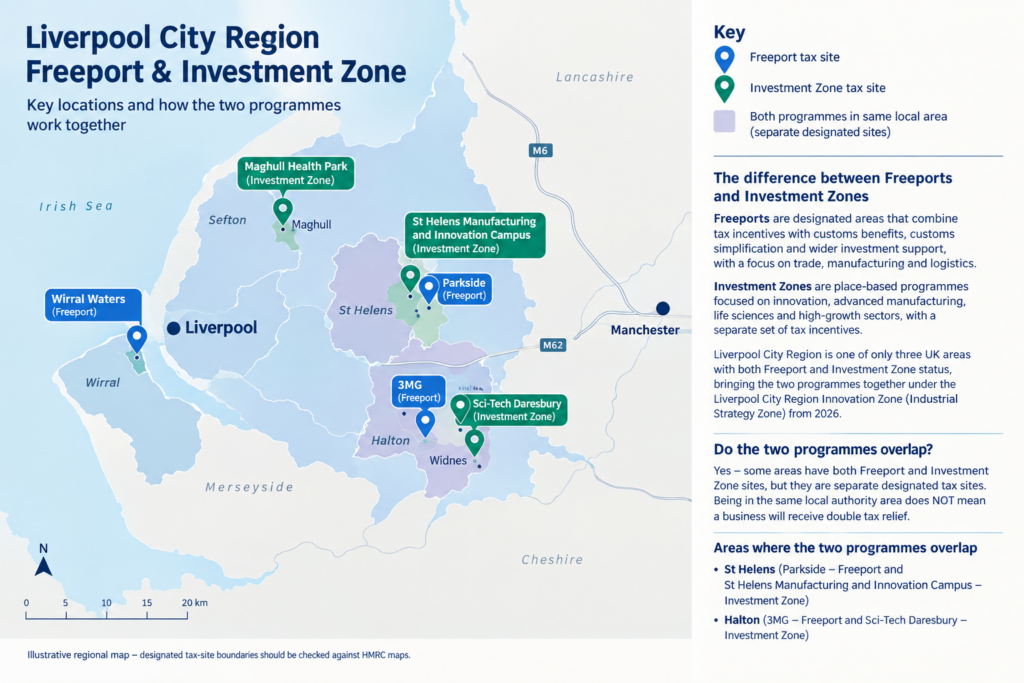
The tax incentives discussed in this article apply specifically to the designated Freeport tax sites. HMRC currently identifies three Liverpool City Region Freeport tax sites:
- Wirral Waters
- Parkside, St Helens
- 3MG, Widnes/Halton
These sites are legally designated geographical areas, so businesses should check the exact site boundaries rather than relying on a general postcode or description of the area.
What are the Liverpool Freeport tax benefits?
1. 100% enhanced capital allowances
One of the most significant incentives is the enhanced capital allowance available for qualifying plant and machinery.
Where the conditions are met, companies can claim a 100% first-year allowance on qualifying expenditure on new and unused plant and machinery for use primarily within a designated special tax site.
That can be particularly valuable for manufacturing, logistics and other businesses making substantial investment in machinery, equipment and operational infrastructure.
The relief is subject to detailed conditions, including requirements around where the plant or machinery is used and whether it is new and unused.
2. Enhanced Structures and Buildings Allowance
Businesses constructing or renovating qualifying non-residential buildings within a special tax site may be able to claim the enhanced Structures and Buildings Allowance at 10% a year.
The standard rate is 3%, so the enhanced rate can bring forward the point at which qualifying expenditure is relieved for tax purposes.
The enhanced allowance can generally be claimed for up to 10 years, subject to the detailed rules and qualifying dates.
For businesses developing or substantially refurbishing industrial, logistics or commercial premises, this can therefore be an important part of the overall investment calculation.
3. SDLT relief
There is also relief from Stamp Duty Land Tax for qualifying acquisitions of land and buildings within a Freeport special tax site.
The relief can apply to commercial land and buildings used in a qualifying way, including certain purchases and leases.
There are important conditions, including a three-year control period. If the property subsequently ceases to be used in a qualifying way, the relief may be withdrawn.
For a business considering a significant property acquisition, SDLT can therefore form an important part of the initial location comparison.
4. Employer National Insurance relief
Eligible employers operating from a Freeport special tax site can potentially benefit from a zero rate of secondary Class 1 National Insurance contributions on qualifying earnings of new employees.
The relief can apply for the first 36 months of employment, subject to the conditions.
One particularly important condition is that the employee must be expected to spend at least 60% of their working time in the relevant special tax site.
The relief applies to employer NICs rather than the employee’s own primary NICs.
For businesses planning to create a significant number of new jobs as part of an expansion, that could have a meaningful effect on employment costs.
5. Business rates relief
Eligible businesses operating within Freeport tax sites may also be able to benefit from business rates relief.
This can apply to new businesses and, subject to the rules, certain existing businesses expanding within a designated tax site.
Business rates treatment should therefore be considered alongside the other tax incentives when assessing the overall cost of a proposed site.
Freeport isn’t just about tax
It is easy to think of a Freeport simply as a collection of tax breaks. In reality, the proposition is broader.
The Liverpool City Region Freeport is also intended to support trade, investment, infrastructure, skills, innovation and regeneration. Customs benefits can also be available to eligible businesses using designated customs sites, although customs sites are separate from tax sites and have their own authorisation requirements.
A business considering moving goods through a Freeport customs site may have different considerations from a business choosing a location specifically to benefit from enhanced capital allowances or SDLT relief.
The right question is therefore not simply whether a business is “in the Freeport”, but which part of the Freeport proposition is relevant to the investment being considered?
Businesses are already investing across the Liverpool City Region
The scale of investment around the Freeport provides some useful real-world context.
SticX: expanding in Wirral
Wirral-based structural timber specialist SticX has invested more than £1m in expanding its operations, acquiring three council-owned industrial units next to its existing facility. The expansion is expected to increase production capacity significantly and support workforce growth.
The project was able to benefit from Freeport Business Rates Relief, demonstrating that the incentives can be relevant to existing businesses expanding their footprint, rather than only to businesses establishing completely new operations.
For a business considering a similar expansion, the potential interaction between business rates, employer NIC relief, capital allowances and property taxes could form an important part of the investment appraisal.
Finsa UK: £20m investment at Wirral Waters
Finsa UK, a sustainable wood-based panel manufacturer with a long-established presence in Birkenhead, has committed around £20m to a new 170,000 sq ft headquarters at Grandidges Quay within the Wirral Waters Freeport tax site.
The development includes a £2m dockside crane and is intended to safeguard existing employment while providing capacity for future growth.
The project illustrates how Freeport status can form part of a much wider investment decision involving property, infrastructure, employment and long-term business growth.
Investment at 3MG and Parkside
There has also been substantial development activity around the other Liverpool City Region Freeport tax sites.
At 3MG in Widnes, the XDock 549 development represents around £67.8m of private-sector investment in a 550,000 sq ft logistics facility, with the potential to support up to 500 jobs.
At Parkside, major investment includes an £80m first phase of development and infrastructure improvements, including the Parkside Link Road connecting the site directly to the M6.
These projects demonstrate the wider investment proposition around the Freeport, although the tax treatment of individual projects will depend on their specific circumstances.
How long will Liverpool Freeport tax reliefs be available?
This is an important point for businesses considering investment now.
The Government extended the window for Freeport and Investment Zone tax reliefs from five years to ten years.
For English Freeport special tax sites, the current sunset date for the main tax reliefs is 30 September 2031.
For Investment Zone special tax sites, the equivalent date is 30 September 2034.
That does not mean every relief simply disappears on those dates or that every claim must be completed in exactly the same way. Each relief has its own qualifying expenditure, transaction and commencement rules.
For businesses considering a major investment, however, the dates make timing and forward planning particularly important.
What is the Liverpool City Region Investment Zone?
The Liverpool City Region also has an Investment Zone, originally established around the region’s strengths in life sciences, innovation and advanced manufacturing.
There are three designated Investment Zone tax sites:
- Maghull Health Park
- St Helens Manufacturing and Innovation Campus
- Sci-Tech Daresbury
Investment Zone tax sites can offer broadly similar incentives to Freeport tax sites, including enhanced capital allowances, enhanced Structures and Buildings Allowance, SDLT relief, employer NIC relief and business rates relief, subject to the relevant conditions.
The important difference is that the Investment Zone programme is not simply another name for the Freeport.
Freeport vs Investment Zone: what’s the difference?
In simple terms:
| Liverpool City Region Freeport | Liverpool City Region Investment Zone | |
| Main focus | Trade, logistics, manufacturing and investment | Innovation, life sciences and advanced manufacturing |
| Tax sites | Wirral Waters, Parkside, 3MG | Maghull, St Helens, Sci-Tech Daresbury |
| Enhanced capital allowances | Yes, subject to conditions | Yes, subject to conditions |
| Enhanced SBA | Yes | Yes |
| SDLT relief | Yes | Yes |
| Employer NIC relief | Yes | Yes |
| Business rates relief | Yes, subject to eligibility | Yes, subject to eligibility |
| Customs benefits | Potentially, through designated customs sites | No equivalent Freeport customs regime |
| Current tax-relief sunset | 30 September 2031 | 30 September 2034 |
The two programmes therefore have considerable similarities from a tax perspective, but they serve different wider economic purposes.
Do the Freeport and Investment Zone overlap?
This is where things get particularly interesting for businesses looking at the Liverpool City Region.
The Government has recognised that having separate programmes operating in the same region can create complexity. Liverpool City Region has therefore brought its Freeport and Investment Zone together within the broader Liverpool City Region Innovation Zone / Industrial Strategy Zone framework.
The six designated tax sites within the new framework are:
- Sci-Tech Daresbury
- St Helens Manufacturing and Innovation Campus
- Maghull Health Park
- Wirral Waters
- Parkside, St Helens
- 3MG in Halton.
The important point for businesses is that overlap does not mean double tax relief.
For example, St Helens has both:
- the Parkside Freeport tax site; and
- the St Helens Manufacturing and Innovation Campus Investment Zone tax site.
Halton similarly has:
- the 3MG Freeport tax site; and
- Sci-Tech Daresbury Investment Zone tax site.
These remain separately designated tax sites with their own rules. A business cannot simply claim two sets of identical reliefs because it happens to be in a local authority covered by both programmes.
What the combined framework does provide is a broader investment proposition and more locations at which businesses can consider the interaction between tax incentives, infrastructure, workforce, sector support and long-term growth.
For an investor, that makes location comparison more important, not less.
Could choosing the right location improve your tax position?
This is where professional tax planning becomes particularly valuable. Imagine a business is considering a major expansion involving:
- the purchase or lease of commercial premises;
- new plant and machinery;
- construction or refurbishment;
- recruitment of additional employees; and
- potentially significant business rates.
The tax outcome could be materially different depending on where that investment takes place.
A business considering a site within a Freeport or Investment Zone tax site should therefore assess the potential impact of:
- capital allowances;
- Structures and Buildings Allowance;
- SDLT;
- employer NICs;
- business rates;
- R&D tax relief, where relevant;
- full expensing or other capital allowance regimes where applicable; and
- wider corporation tax implications.
The objective is not simply to find a location offering the biggest headline incentive. It is to understand the overall commercial and tax outcome.
That is particularly important where a business has genuine flexibility over where it locates a new facility, acquires property or undertakes a major capital project.
What other tax incentives should Liverpool businesses consider?
Freeport and Investment Zone reliefs should not be considered in isolation. Depending on the nature of the business and the investment, other incentives may be relevant.
R&D tax relief
Businesses do not have to be pharmaceutical companies or laboratories to carry out qualifying R&D.
Manufacturers, engineers, software businesses, technology companies and other businesses may undertake qualifying work when developing new products, processes or software or overcoming technological uncertainties.
Capital allowances and full expensing
Businesses making significant capital investments should also consider the wider capital allowance regime. Full expensing remains an important incentive for qualifying companies investing in certain plant and machinery, while other first-year allowances and capital allowance rules may apply depending on the expenditure and the business.
The interaction with Freeport or Investment Zone reliefs needs to be considered carefully because the same expenditure cannot simply be relieved twice.
Business rates
Businesses should also consider national and local business rates reliefs alongside any Freeport or Investment Zone incentives. The fact that a business does not qualify for a particular special tax-site relief does not necessarily mean there are no other business rates opportunities.
Sector-specific investment support
The Liverpool City Region is also focusing investment and support around areas including life sciences, advanced manufacturing, digital technology, maritime and logistics.
The region’s new Industrial Strategy Zone is intended to bring together investment, infrastructure, skills and business support alongside the tax incentives available at its designated sites. The programme is backed by £185m of Government funding and is intended to unlock a further £800m of investment and create up to 8,000 jobs over the next decade.
What about businesses in Manchester?
This is also relevant for businesses operating across both Liverpool and Manchester. Greater Manchester has an Investment Zone, but it has taken a different approach to Liverpool City Region and has not designated Investment Zone tax sites.
That means businesses should not assume that simply operating within Greater Manchester gives them access to the specific Investment Zone tax-site reliefs discussed above.
For a business with operations or investment opportunities in both cities, the comparison therefore needs to look at the actual location, investment and available incentives rather than simply assuming that both regions offer the same tax treatment.
How can UHY Williamson Croft help?
The most valuable time to consider Freeport and Investment Zone tax incentives is before a significant investment decision has been made. At UHY Williamson Croft, we can help businesses assess the tax implications of proposed investment and consider how location, property and capital expenditure could affect the overall outcome.
This can include:
- assessing whether a proposed location falls within a designated special tax site;
- identifying which Freeport or Investment Zone reliefs could potentially apply;
- reviewing planned capital expenditure and property investment;
- considering capital allowances and Structures and Buildings Allowance;
- assessing potential SDLT and employer NIC savings;
- considering R&D tax relief and other available incentives;
- comparing different investment scenarios; and
- helping businesses understand the tax implications before committing to a major project.
For property investors, developers and businesses undertaking substantial capital investment, this assessment can be particularly valuable because the tax consequences can form a significant part of the overall project economics.
The bottom line
Liverpool City Region has an unusually broad range of investment incentives. The Freeport offers significant potential tax benefits at Wirral Waters, Parkside and 3MG, while the Investment Zone provides a further three designated tax sites at Maghull, St Helens and Sci-Tech Daresbury.
The creation of the wider Liverpool City Region Innovation Zone/Industrial Strategy Zone makes the region’s investment proposition more joined-up, but it does not mean that businesses can simply combine or double up identical tax reliefs.
For businesses planning a major investment, the key question is therefore: Could choosing a different location, investment structure or timing improve the overall tax outcome?
That question is worth answering before the investment is committed.
About the author
Taylor Rogers, FCCA, Partner at UHY Williamson Croft
Taylor joined Williamson Croft in 2017 and became a Partner in November 2025. He supports clients with accountancy and tax needs and has particular experience in the property sector, working with developers, investors, construction businesses and other clients on financial and tax considerations. Contact Taylor below.
Sources and further information
This article has been researched using current HMRC/GOV.UK guidance and Liverpool City Region Combined Authority information, together with publicly available information about local investment projects.
The position on Freeport and Investment Zone tax reliefs can change following Government announcements and Budgets. The information above was reviewed in September 2026 and is intended as general guidance rather than specific tax advice.
Official HMRC maps: Businesses should check the legally designated tax-site boundaries before relying on any Freeport or Investment Zone relief. HMRC’s Liverpool City Region Freeport maps identify the boundaries of the three Freeport tax sites, while separate HMRC maps identify the three Investment Zone tax sites.
Frequently asked questions about Liverpool Freeport and Investment Zones
What is the Liverpool City Region Freeport?
The Liverpool City Region Freeport is a designated 45km area covering the Liverpool City Region. Its wider objectives include supporting trade, investment, jobs, infrastructure and regeneration. Its three designated tax sites are Wirral Waters, Parkside in St Helens and 3MG in Halton.
What tax benefits are available in the Liverpool Freeport?
Depending on eligibility, businesses within the designated Freeport tax sites may benefit from enhanced capital allowances, enhanced Structures and Buildings Allowance, SDLT relief, employer National Insurance relief and business rates relief.
Does every business in Liverpool qualify for Freeport tax relief?
No. Freeport tax reliefs are generally available only within the designated Freeport special tax sites and are subject to specific conditions. A Liverpool or Merseyside postcode does not automatically qualify a business for Freeport tax relief.
Where are the Liverpool Freeport tax sites?
The three designated Liverpool City Region Freeport tax sites are Wirral Waters, Parkside in St Helens and 3MG in Halton. The precise boundaries are shown on HMRC’s official maps.
How long will Liverpool Freeport tax reliefs be available?
The current sunset date for the main tax reliefs in English Freeport special tax sites is 30 September 2031, subject to the specific rules applying to each relief.
What is the Liverpool City Region Investment Zone?
The Liverpool City Region Investment Zone is a place-based programme focused particularly on life sciences, innovation and advanced manufacturing. Its three designated tax sites are Maghull Health Park, St Helens Manufacturing and Innovation Campus and Sci-Tech Daresbury.
What is the Liverpool City Region Innovation Zone?
The Liverpool City Region Innovation Zone is the broader framework bringing together the region’s Freeport and Investment Zone programmes, alongside investment in infrastructure, innovation, skills and economic growth.
Do the Liverpool Freeport and Investment Zone overlap?
They overlap at a regional level and the programmes have been brought together under the wider Industrial Strategy Zone framework. There are also local authority areas, including St Helens and Halton, containing both a Freeport tax site and an Investment Zone tax site. The individual tax sites remain separately designated.
Does being in an area covered by both schemes mean a business gets double tax relief?
No. Businesses cannot simply claim two sets of identical tax reliefs because they are located in an area covered by both programmes. The relevant reliefs and eligibility conditions must be assessed for the specific investment and site.
Can an existing business benefit from the Liverpool Freeport?
Potentially, yes. Freeport incentives are not limited to completely new businesses. For example, eligible existing businesses expanding within a designated tax site may be able to benefit from business rates relief, while other incentives may apply depending on the investment and relevant conditions.
What other tax reliefs should Liverpool businesses consider?
Depending on the business and project, other opportunities may include R&D tax relief, capital allowances, full expensing and other business rates or sector-specific incentives. The most appropriate combination will depend on the nature of the investment.
Does Greater Manchester have an Investment Zone?
Greater Manchester has an Investment Zone programme, but it has not designated Investment Zone tax sites. Businesses should therefore not assume that the specific tax-site reliefs available in Liverpool City Region apply simply because they operate in Greater Manchester.
When should a business seek advice about Freeport or Investment Zone tax relief?
Ideally, before committing to a property purchase, lease, development or major capital investment. Considering the tax position early can allow a business to compare locations, investment structures and timings before decisions become difficult or expensive to change.